Who it is for
TAVI is used for severe, symptomatic aortic stenosis (echocardiographic criteria as for surgery: area ≤ 1.0 cm², mean gradient ≥ 40 mmHg, velocity ≥ 4.0 m/s). The choice between TAVI and surgery is made by the Heart Team. The 2025 ESC/EACTS guidelines recommend TAVI as the preferred method in patients aged ≥ 70 years with anatomy suitable for access through the femoral artery, and also in younger patients with high surgical risk. Surgery is preferred in younger patients, with a bicuspid valve and a dilated aorta, with coexisting coronary artery disease requiring bypasses, with infective endocarditis, or when the anatomy makes safe implantation of the prosthesis difficult.
TAVI can also be performed inside a worn-out biological prosthesis from a previous operation ("valve-in-valve"), which avoids a repeat sternotomy.
Assessment requires: echocardiography, coronary angiography (or CT angiography of the coronary arteries) and a CT angiogram of the heart and the entire aorta, assessing the valve annulus, the height at which the coronary arteries arise, and the iliac and femoral arteries.
What it involves
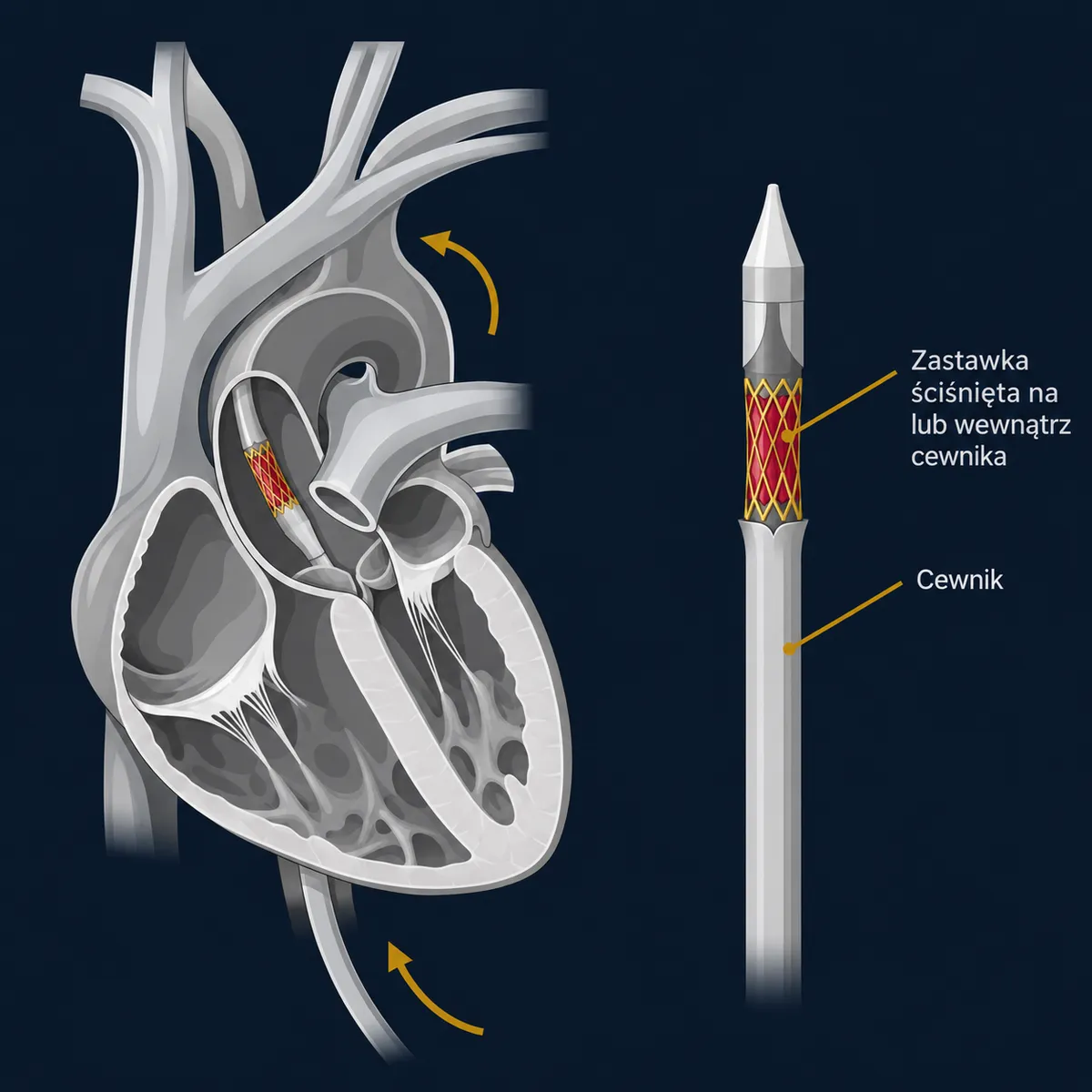
Two main types of prosthesis are used: balloon-expandable and self-expanding; both consist of leaflets made from animal pericardium mounted on a metal frame. The choice depends on the anatomy of the annulus, calcification and the risk of conduction disturbances.
Access:
- transfemoral — in more than 90% of patients, through a puncture of the femoral artery, without a surgical incision;
- alternative (through the subclavian artery, carotid artery or the apex of the heart) — when the iliac arteries are too narrow or tortuous.
The procedure is performed jointly by a team of interventional cardiologists and cardiac surgeons in a hybrid operating room, under fluoroscopy and echocardiography guidance.
The procedure and hospital stay
The procedure usually takes 1–2 hours, most often under local anaesthesia with sedation (you sleep lightly and breathe on your own); general anaesthesia is used for alternative access routes. A temporary pacing wire is introduced through a vein; at the moment the valve is expanded, the heart is paced very fast for a few seconds to stop the blood flow. After the procedure the puncture site is closed with a percutaneous suture system.
First day: monitoring of the heart rhythm (risk of heart block), lying flat for 4–6 hours, then getting up. Before discharge: echocardiography, ECG, check of the puncture site.
Typical stay: 2–4 days after an uncomplicated transfemoral procedure.
Recovery
- No breastbone wound: return to normal activity within 1–2 weeks; restrictions apply only to the groin (no lifting or strenuous exercise for about a week).
- Driving is usually possible after 1–2 weeks, following a check-up.
- Medicines: usually aspirin indefinitely; in patients with atrial fibrillation — an anticoagulant instead of aspirin. The regimen is decided by your doctor.
- Prevention of endocarditis before dental procedures — as with any valve prosthesis.
- Echocardiographic check-ups after 30 days, after a year, then every year.
- Cardiac rehabilitation is recommended, especially for people who were weakened before the procedure.
Risks and alternatives
As an approximate guide, for transfemoral access in a low-risk patient (data from randomised trials and registries):
- death within 30 days: 1–2%;
- stroke: 1–3%;
- need for a pacemaker because of heart block: 5–15% (more often with self-expanding prostheses and in patients with pre-existing conduction disturbances) — this is the main advantage of surgery over TAVI;
- paravalvular leak — minor in some patients; a significant leak requires treatment;
- vascular complications in the groin (haematoma, false aneurysm, dissection): 2–5%;
- acute kidney injury after contrast: a few per cent, usually temporary;
- blockage of a coronary artery opening or rupture of the annulus: rare (< 1%) but dangerous — the risk is assessed on the CT angiogram before the procedure.
Durability: 5–10-year data are comparable with surgically implanted biological prostheses; full data beyond 10–15 years are not yet available, which matters in younger patients.
Alternatives: surgery (SAVR) — longer-term data, lower risk of a pacemaker and leak, the possibility of treating the coronary arteries and aorta at the same time, but longer recovery; medical treatment — does not stop the disease.
More on how the choice between surgery and a transcatheter procedure is made →
Questions
Is TAVI "easier" than surgery?
For the patient — less demanding and with a shorter recovery. However, it is not a risk-free procedure and requires the same diagnostic tests as surgery.
Can a TAVI valve be replaced?
Yes, in many cases via a catheter ("TAVI-in-TAVI"), provided the anatomy is suitable; this is planned already at the first procedure, among other things by choosing the implantation height.
Is TAVI performed in patients with a bicuspid valve?
Yes, in selected patients, but bicuspid anatomy is more difficult and surgery is more often recommended, especially in younger people.
How long is the wait?
After assessment, it depends on the centre and the urgency; severe stenosis with symptoms is treated as a priority, because the risk of sudden deterioration is real.
Do I need to change my lifestyle?
The procedure treats the valve, not other conditions. Controlling blood pressure, cholesterol and diabetes, and staying physically active, remain essential.