Who is it for
According to the ESC 2024 guidelines on atrial fibrillation:
- A catheter-based or epicardial procedure is considered in patients with atrial fibrillation and an increased risk of stroke (CHA₂DS₂-VA score) in whom anticoagulant treatment is contraindicated in the long term: after serious bleeding (e.g. intracranial bleeding, or gastrointestinal bleeding that keeps recurring despite treatment), with conditions that increase the risk of bleeding (low platelet count, angiodysplasia, cerebral amyloid angiopathy), with occupational or lifestyle exposure to injury, and also in patients who have had a stroke despite proper anticoagulation.
- Closure during heart surgery — recommended in patients with atrial fibrillation having surgery for another reason (LAAOS III trial: stroke risk reduced by about one third, regardless of whether anticoagulation is continued).
The procedure is not an alternative to medication for a patient who can take it and tolerates it well — data from trials comparing the two strategies in this group are still being collected.
What it involves
Three families of methods:
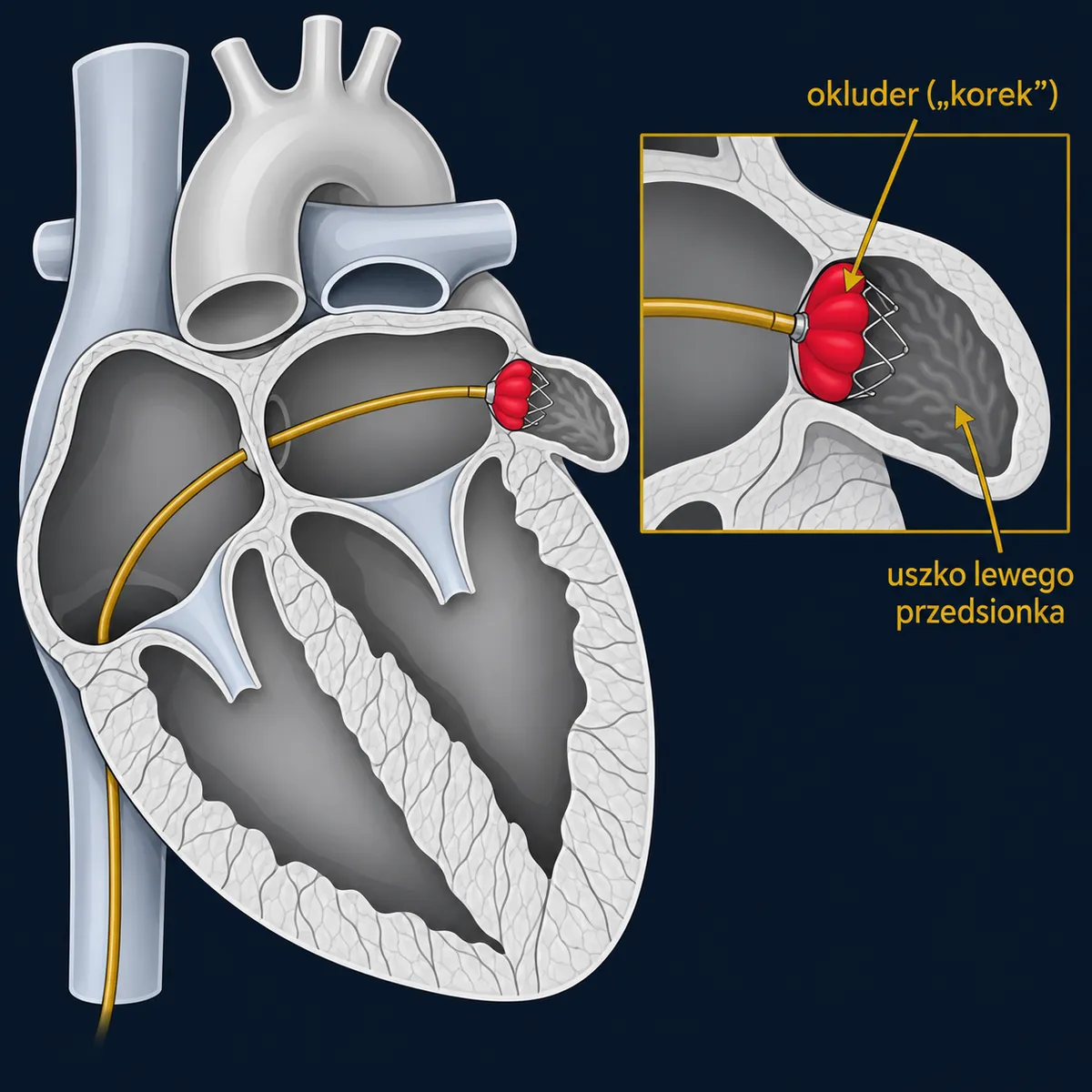
- Intracardiac (endocardial) occluders — an occluder (e.g. Watchman FLX, Amplatzer Amulet) is passed through the femoral vein and a puncture of the interatrial septum into the appendage, where it fills it or seals it off from the atrial side. This is the most widely used method, performed by interventional cardiologists. After the procedure it requires several months of antithrombotic treatment until the occluder is covered with tissue.
- Epicardial ligation (LARIAT) — a combination of access through a puncture of the pericardium and through the septum: the appendage is caught from the outside with a loop and tied off; no foreign body is left in the heart, and the appendage is also cut off electrically (which is sometimes used in treating arrhythmia). The method is used in patients in whom a foreign body in the heart is undesirable, when the anatomy is unsuitable for an occluder, or when medication cannot be used even briefly. Used in Poland since 2009, with long-term follow-up extending beyond 10 years; purely epicardial systems (e.g. Sierra) are also being developed.
- Surgical closure — during heart surgery: an external clip (AtriClip), stitching or removal of the appendage. A standard addition to mitral valve surgery and atrial fibrillation ablation.
The choice of method depends on the anatomy of the appendage (CT angiography or transoesophageal echocardiography), previous heart surgery (adhesions in the pericardium prevent epicardial access), whether medication can be used after the procedure, and the experience of the centre.
What to expect
Assessment: transoesophageal echocardiography (ruling out a clot in the appendage — an absolute requirement), cardiac CT angiography with measurement of the appendage, kidney function tests, a neurology or gastroenterology consultation where relevant.
Catheter-based or epicardial procedure: general anaesthesia or deep sedation, 1–2 hours, guided by transoesophageal echocardiography and fluoroscopy. After an epicardial procedure a drain is left in the pericardium for a day. Hospital stay: 2–4 days.
Recovery
- Return to normal activity within 1–2 weeks (the groin is healing; after epicardial access there may be chest pain for a few days, treated with anti-inflammatory drugs).
- Medication after the procedure: after an occluder — usually an anticoagulant or dual antiplatelet therapy for 6–12 weeks, then aspirin; the regimen is tailored to the reason why anticoagulation could not be used. After epicardial ligation — most often antiplatelet treatment only, or none, as decided by your doctor.
- Follow-up: transoesophageal echocardiography or CT angiography at 6–12 weeks (completeness of closure, clot on the occluder) and at one year.
- Prevention of infective endocarditis for 6 months after an occluder is implanted.
Risks and alternatives
Intracardiac occluders (registry data): serious complications around the time of the procedure 1–3% — tamponade, embolism, blood vessel complications, displacement of the occluder (< 1%); a clot on the occluder in 2–4% in the first year, usually treated with temporary anticoagulation; a residual leak > 5 mm in a few per cent of patients. Epicardial ligation: the main risk is bleeding into the pericardium (2–5%) and pericarditis; the absence of a foreign body eliminates the risk of a clot on the device. In long-term follow-up, the effectiveness of both methods in preventing stroke is comparable to anticoagulant treatment in the groups studied.
Alternatives: anticoagulant drugs (NOAC) — the standard for patients who can take them; treating the cause of bleeding (e.g. removing a polyp, changing medication), allowing a return to anticoagulation; no prevention — acceptable only when stroke risk is very low.
More on how the choice between surgery and a transcatheter procedure is made →
Questions
After appendage closure, can I definitely stop anticoagulants?
That is the aim of the procedure in patients for whom these drugs are contraindicated. The decision is made after a follow-up imaging test confirms that the closure is complete and there is no clot, and it is made by your doctor.
Occluder or LARIAT?
An occluder is the more widely available method; epicardial ligation makes sense when a foreign body is undesirable, the anatomy of the appendage is unusual, or no antithrombotic drugs at all can be used. Both approaches have their anatomical limitations.
Does the procedure treat atrial fibrillation?
No. It reduces the risk of stroke; the arrhythmia remains and needs its own treatment. Epicardial ligation may additionally reduce recurrences of the arrhythmia in some patients, but it is not a method of treating it.
Does closing the appendage affect the heart?
The appendage releases natriuretic hormone; after it is closed off, temporary hormonal changes and a tendency to retain fluid are seen in the first weeks, with no significant clinical consequences in long-term follow-up.