Who it is for
Surgery is offered to patients with coronary artery disease in whom medical treatment is not enough and stenting (PCI) does not give equally good long-term results. According to the European guidelines (ESC/EACTS), the advantage of surgery over stents has been shown particularly in the following situations:
- multivessel disease — narrowings in two or three main arteries, especially with complex anatomy (a high SYNTAX score);
- narrowing of the left main coronary artery, especially together with disease of other vessels;
- diabetes with multivessel disease;
- reduced ejection fraction of the left ventricle, if the muscle is viable and can recover its function once blood supply is restored;
- the need for simultaneous valve or aortic surgery.
The decision is made by the Heart Team — a cardiologist, an interventional cardiologist and a cardiac surgeon — on the basis of coronary angiography, echocardiography and risk assessment. You have the right to hear the arguments for both options.
What it involves
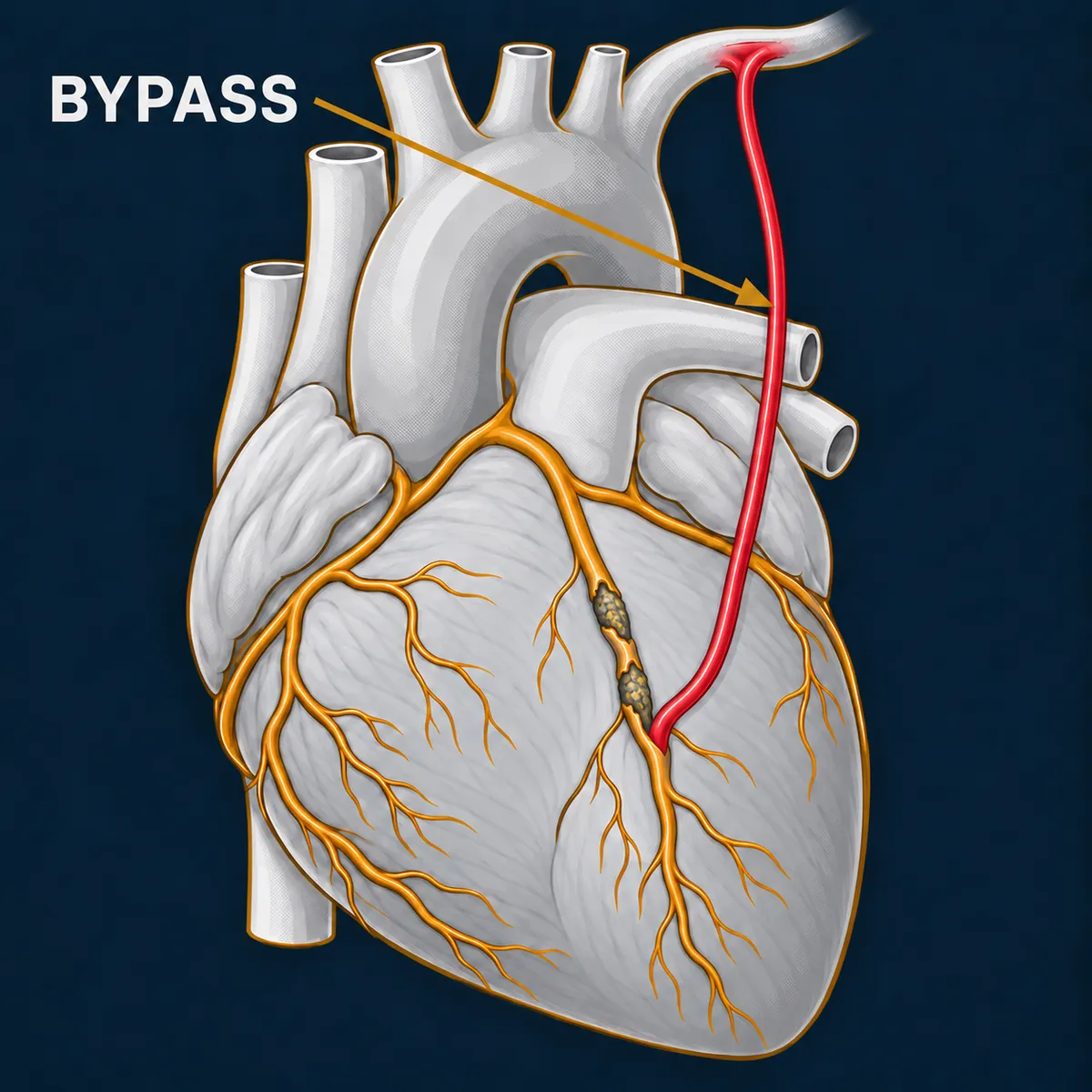
The patient's own blood vessels are used as grafts:
- Left internal mammary (thoracic) artery (LIMA) — the standard; a LIMA graft to the left anterior descending artery (LAD) remains open in more than 90% of cases after 10 years and is the main reason for the advantage of CABG over stents.
- Right internal mammary artery (RIMA) and the radial artery from the forearm — used for arterial revascularisation in younger patients, in whom grafts need to last for decades.
- Great saphenous vein from the lower leg — the most common additional graft material; its patency is lower than that of arterial grafts.
The operation can be performed:
- using cardiopulmonary bypass (on-pump) — the heart is stopped and the pump takes over the circulation; the reference method;
- on the beating heart (OPCAB, off-pump) — without the pump, using a stabiliser that holds part of the heart still; used in selected patients, including those with an aorta affected by atherosclerosis;
- minimally invasively (MIDCAB) — through a 5–8 cm incision between the ribs on the left side, without dividing the breastbone; usually a single LIMA–LAD graft, on the beating heart. In selected patients MIDCAB is combined with stenting of the remaining vessels (hybrid revascularisation).
The choice of technique depends on the anatomy of the narrowings, the condition of the aorta, age, other conditions and the experience of the centre.
The hospital stay
Patients are usually admitted the day before surgery. The operation takes 3–5 hours under general anaesthesia. In conventional CABG access is gained by dividing the breastbone (sternotomy); in MIDCAB through a side incision. After surgery the patient goes to the intensive care unit, where they are usually woken up and taken off the ventilator within a few to a dozen or so hours. Chest drains are removed on day 1–3. Getting up and breathing exercises start from the first day.
Typical hospital stay: 5–7 days after sternotomy, 3–5 days after MIDCAB. Discharge takes place once pain is under control, the wound is healing well and the heart rhythm is stable.
Recovery
- After sternotomy the breastbone takes 6–8 weeks to heal. During this time restrictions apply: do not lift more than 3–5 kg, do not push up on your arms when getting up, do not drive (usually for 4–6 weeks). Return to office work after 6–8 weeks, to physical work after 3 months.
- After MIDCAB there are no restrictions related to the breastbone; return to normal activity usually within 2–4 weeks.
- Cardiac rehabilitation (inpatient or outpatient) is recommended for every patient; it improves fitness and reduces the risk of further events.
- Medicines: aspirin indefinitely, a high-dose statin, and medicines depending on other conditions. Further treatment is decided by your doctor.
- Wounds on the leg (where the vein was taken) heal more slowly; swelling of the lower leg may persist for several weeks.
Risks and alternatives
The risk depends on age, heart function and other conditions; it is assessed using the EuroSCORE II or STS scores. As an approximate guide, for a planned operation in a patient without serious additional conditions:
- death around the time of surgery: 1–3%;
- stroke: 1–2%;
- heart attack around the time of surgery, need for re-operation because of bleeding: 2–4%;
- atrial fibrillation after surgery: 20–40% — usually temporary, but requires treatment;
- breastbone wound infection: 1–3%, more common in people with diabetes and obesity;
- problems with memory and concentration in the first weeks: common, usually resolve.
Alternatives: stenting (PCI) — less demanding, quicker return to activity, but in multivessel disease and diabetes it is associated with a more frequent need for repeat procedures and higher long-term mortality; medical treatment — for patients with stable angina and simple anatomy, or when the risk of a procedure outweighs the benefit.
More on how the choice between surgery and a transcatheter procedure is made →
Questions
How long do bypasses last?
In most patients the LIMA–LAD arterial graft stays open for 15–20 years or longer. Vein grafts narrow more often after 8–10 years. Durability also depends on controlling cholesterol and blood pressure, and on not smoking.
Do I need to take medicines after the operation?
Yes. The operation bypasses the narrowings but does not cure atherosclerosis. Medicines and lifestyle changes protect both the grafts and your own arteries.
Is MIDCAB as effective as conventional surgery?
For a LIMA–LAD graft the results are comparable. MIDCAB does not replace full surgery when three or four vessels need to be bypassed — in that case a sternotomy or hybrid treatment is considered.
When can I return to sex, sport and air travel?
Usually after 4–6 weeks, following a check-up with your doctor; flying is usually possible after 2–4 weeks if recovery is uncomplicated.
Will I need a blood transfusion?
Some patients do. Anaemia is treated before surgery to reduce this need.