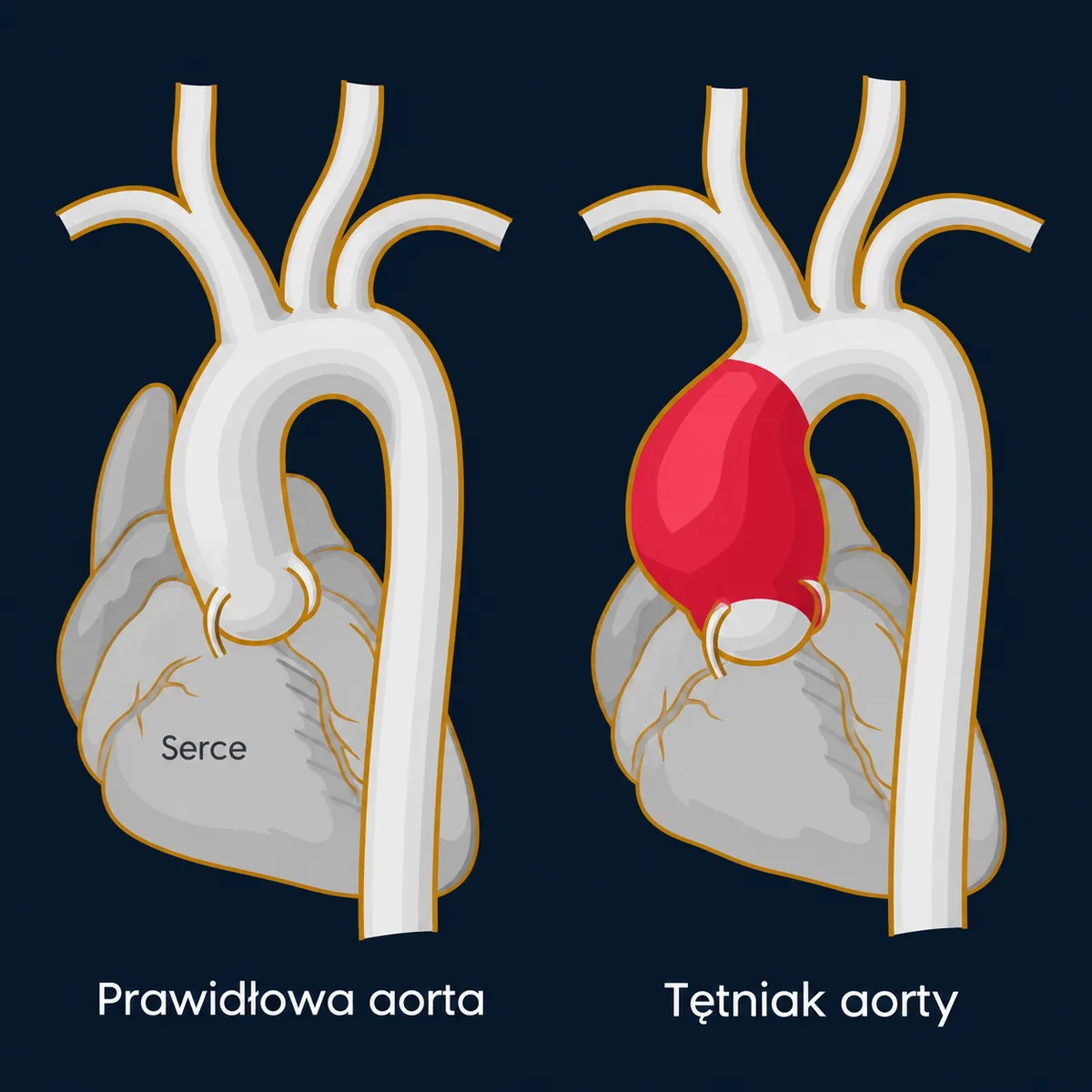
Who is it for
Surgical thresholds (ESC 2024 guidelines on aortic diseases and ESC/EACTS 2025 guidelines on valvular heart disease) — given as a guide, since height, sex and the rate of enlargement are also taken into account:
- diameter ≥ 55 mm — an indication in every patient;
- ≥ 50 mm — with a bicuspid valve and risk factors (family history of dissection, resistant high blood pressure, rapid growth > 3 mm/year, coarctation), in Marfan syndrome and other genetic aortic diseases; in Loeys-Dietz syndrome and with certain mutations even lower (≥ 45 mm);
- ≥ 45 mm — when aortic valve surgery is planned for another reason (the aorta is then replaced as well, to avoid a second operation);
- growth ≥ 3 mm/year on repeated measurements — regardless of the absolute diameter;
- in shorter people the thresholds are lowered by indexing the diameter to body surface area or height (ASI, HSI indices).
Widening below the thresholds is monitored: CT angiography or MRI every 6–12 months for a diameter of 45–54 mm, less often for smaller ones; high blood pressure is treated, stopping smoking is advised, and sports involving very heavy isometric effort should be avoided.
What it involves
The extent of the operation depends on which segments are widened and whether the aortic valve is healthy:
- Supracoronary replacement of the ascending aorta — when the aortic root (the segment next to the heart containing the openings of the coronary arteries) and the valve are normal: the widened segment is replaced with a synthetic vascular graft (Dacron).
- Aortic root replacement preserving your own valve (David, reimplantation; Yacoub, remodelling) — when the root is widened but the valve leaflets are healthy; your own valve is sewn inside the graft, and the coronary arteries are re-attached to it. This avoids a prosthetic valve and anticoagulation.
- Bentall operation — when both the root and the valve need replacing: a composite graft (a mechanical or biological valve sewn into a vascular graft) with reimplantation of the coronary arteries.
- Hemiarch — when the widening extends to the beginning of the aortic arch: the ascending aorta and the lower part of the arch are replaced during a brief circulatory arrest under deep or moderate hypothermia, with the brain protected by selective perfusion of the arteries supplying the head. Extensive arch operations (including the frozen elephant trunk technique) are described elsewhere.
What to expect
Assessment: ECG-gated CT angiography of the whole aorta (precise measurements), echocardiography (valve, ventricular function), coronary angiography or coronary CT angiography; in younger patients with a suspected genetic condition — genetic counselling and testing of family members.
The operation is performed under general anaesthesia with cardiopulmonary bypass, through a full sternotomy (a mini-sternotomy is possible for isolated replacement of the ascending aorta), taking 3–6 hours depending on its extent. One or two days in intensive care.
Typical hospital stay: 7–10 days.
Recovery
- Protect the breastbone for 6–8 weeks; cardiac rehabilitation is recommended.
- Blood pressure control is part of the treatment after this operation: the target is usually < 130/80 mmHg, with a beta-blocker or an angiotensin receptor blocker (sartan) as advised by your doctor.
- Anticoagulation: only after a mechanical valve (lifelong); after a David operation and a biological valve — usually aspirin or short-term anticoagulation.
- Lifelong imaging of the whole aorta: CT angiography or MRI at 6–12 months, then every 1–3 years — the remaining segments of the aorta (arch, descending aorta) may widen, especially in genetic conditions.
- Screening of first-degree relatives (echocardiography) — recommended with a bicuspid valve and an aneurysm in a young person.
Risks and alternatives
As a guide, for planned surgery in a patient without serious other health problems: death 1–3% (isolated replacement of the ascending aorta), 2–5% (aortic root operations, hemiarch); stroke 1–3% (higher with arch operations); bleeding requiring re-operation 3–6%; pacemaker 2–4%. For comparison: the mortality of acute type A aortic dissection is about 1–2% per hour in the first days without surgery, and about 15–25% despite emergency surgery — this is the main argument for planned surgery once the thresholds are exceeded.
Alternatives: observation and medical treatment — appropriate below the thresholds; medication does not shrink the aneurysm, it slows its growth; stent graft (TEVAR) — used in the ascending aorta only exceptionally, in patients unsuitable for surgery, in specialist referral centres; surgery remains the standard.
More on how the choice between surgery and a transcatheter procedure is made →
Questions
My aneurysm is 48 mm and I have no symptoms — why not operate yet?
Because below the threshold the risk of dissection within a year is lower than the risk of surgery. The thresholds were set precisely on the basis of this balance. Exceptions are genetic conditions, a bicuspid valve with risk factors, and rapid growth.
Can an aneurysm be "cured" with medication?
No. Blood pressure-lowering drugs slow growth and reduce the risk of dissection, but they do not reduce the diameter.
Is the David operation durable?
In experienced centres over 90% of patients do not need further valve surgery after 10 years. Healthy leaflets are a prerequisite.
How long before I can exercise?
Once the breastbone has healed and after rehabilitation, you can return to endurance activities. After the operation, prolonged maximal isometric effort (weights) is avoided, especially in genetic aortic diseases.
Should the patient's children be checked?
With a bicuspid valve, Marfan syndrome or an aneurysm at a young age — yes; echocardiography of first-degree relatives is recommended.